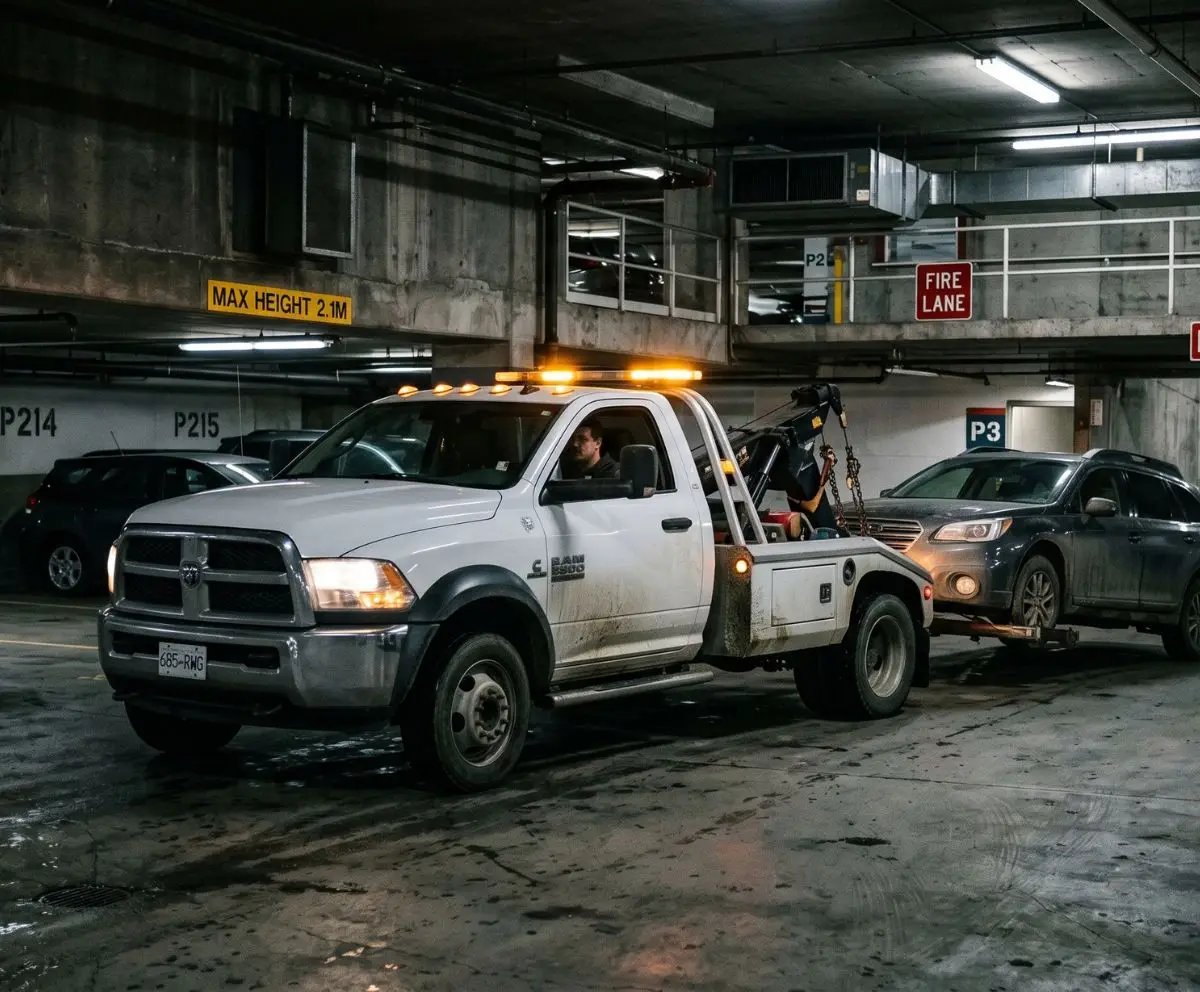
A vehicle that breaks down in an underground parkade can be more difficult to move than one parked at street level. Before arranging underground parkade towing, the first question is whether suitable equipment can reach the vehicle and move it out of the garage.
The posted entrance clearance is important, but it is only part of the assessment. Ramps, tight turns, parking spaces, building access and the vehicle’s condition can all affect the pickup.
If you need a tow from an underground parkade, start by sharing the correct entrance, posted clearance, parking level and what you know about the vehicle’s condition. Roadside Link can use this information to look for a suitable available independent provider. The accepting provider determines whether the pickup is feasible.
Identify the Correct Parkade Entrance
An underground garage may have separate entrances for residents, visitors and service vehicles. The street address alone may not identify the entrance that leads to your car.
When arranging the pickup, provide:
- The building address and correct garage entrance
- The posted height clearance
- The parking level and stall number
- Any gate, fob or access-code restrictions
- The vehicle’s position within the parking space
If the entrance is on a different street or lane from the building’s main address, mention that.
You can also describe the clearance sign or share a photograph if one can be taken safely and the request channel supports receiving it. Written information is sufficient to begin discussing the request.
Do not assume that a towing vehicle can enter because another truck has used the garage before. The responding provider needs to assess the dimensions and movement requirements of its own equipment.
Why Clearance Is Only Part of Underground Towing
A garage may have enough height at the entrance but still present difficulties farther inside.
Several conditions can affect access:
- Steep ramps: The slope and changes in grade may affect how equipment approaches or moves a vehicle.
- Tight turns: A narrow or curved driving lane can limit manoeuvring room.
- Low sections: Pipes, overhead structures or other restrictions may reduce clearance along the route.
- Parking-space layout: Columns, walls, adjacent vehicles or limited room around the stall may complicate access.
- Restricted entrances: Gates and building rules may limit when or how service equipment can enter.
Describe these conditions if you already know about them. The provider can then consider whether the available equipment and proposed method are appropriate.
The broader guide to choosing a suitable tow truck explains why the pickup environment matters alongside the vehicle’s size, drivetrain and condition.
Explain Whether the Vehicle Can Be Moved
A vehicle that will not start is not necessarily ready to be rolled or loaded.
The provider may need to know whether the vehicle can steer, whether its wheels can turn freely and whether its brakes can be released using an appropriate procedure.
Provide the year, make and model, along with anything you already know about:
- Whether the vehicle starts or powers on
- Whether the keys or electronic key are available
- Whether it can roll or steer
- Whether the parking brake or transmission prevents movement
- Any flat tires, wheel damage or collision-related problems
- Whether the vehicle is AWD, 4WD, electric or modified
You do not need to test the vehicle to answer these questions. If you are unsure, simply say so.
Do not release the brakes, attempt to push the vehicle up a ramp or move it into a traffic lane to prepare for a tow. The provider must determine how the vehicle can be moved.
For electric and all-wheel-drive vehicles, the exact model can be especially important. The considerations in AWD and EV towing may affect the transport method even after the vehicle has been moved out of the garage.
What If a Flatbed Tow Truck Cannot Enter the Parkade?
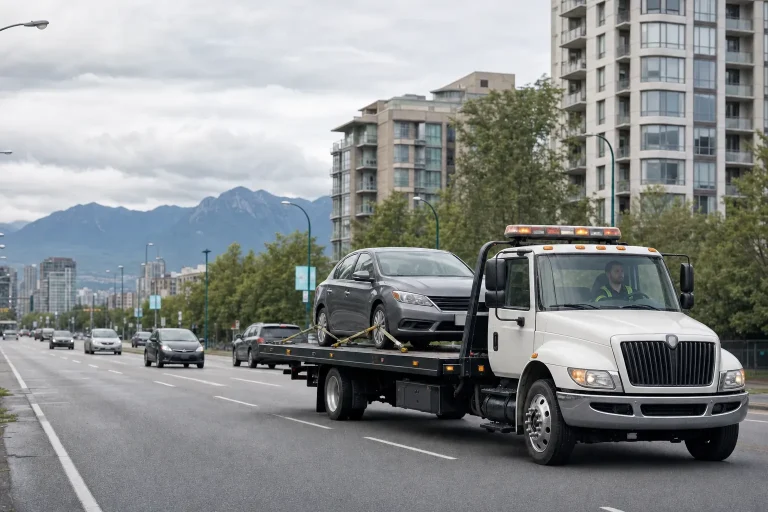
A flatbed may be suitable for transporting a particular vehicle, but its height or manoeuvring requirements may prevent it from reaching an underground stall.
In some situations, a provider may determine that a different method or suitable equipment is needed to move the vehicle to an accessible loading area.
That approach depends on the garage layout, vehicle condition, available equipment and the provider’s assessment. It should not be assumed to be possible at every property.
Do not attempt to push, drag or pull the vehicle out yourself to make loading easier.
If flatbed towing is appropriate for the onward journey, the provider still needs to establish how the vehicle can be reached and moved out of the garage.
Before authorizing additional work, ask the provider to explain the proposed approach and how it affects the price whenever circumstances allow.
Coordinate Building Access Before Pickup
Building access can influence whether a towing request can proceed.
If the parkade is controlled by a property manager, concierge, strata representative or another authorized contact, establish who can grant the necessary access.
Confirm any applicable requirements, including whether someone must open a gate, meet the provider or authorize the vehicle’s movement.
If the vehicle belongs to someone else, the person arranging the tow must have appropriate authority to request its removal or transportation.
Give the provider the relevant access contact details through the agreed request channel. Avoid sharing access codes or insecure key arrangements publicly.
Confirm the Towing Destination
The next step is deciding where the vehicle should go.
If the destination is a repair shop or dealership, provide its exact address and confirm that it can receive the vehicle.
For a pickup outside the shop’s operating hours, discuss delivery permission, key handling and drop-off instructions with the receiving business in advance. Do not assume the vehicle can be left outside a closed facility.
These arrangements can affect the timing and scope of the job.
When discussing pricing, ask whether the proposed quote includes the underground pickup, any additional movement needed before loading, transportation and applicable waiting or access-related charges.
Underground Parkade Towing Checklist
Before contacting dispatch, gather the information you already have.
Pickup location
- Building address and correct entrance
- Posted entrance clearance
- Parking level and stall number
- Known ramp, turning and overhead restrictions
- Gate or building-access requirements
Vehicle information
- Year, make and model
- Drivetrain or electric-vehicle status, if known
- Keys and vehicle access
- Known rolling, steering or braking limitations
- Visible tire, wheel or collision damage
Pickup and delivery arrangements
- Authorized building-access contact
- Intended towing destination
- Repair-shop receiving hours
- Agreed key and delivery instructions
Missing information can be identified during the request. You do not need to inspect an unsafe area or perform a technical assessment yourself.
Request a Tow From an Underground Parkade
Roadside Link Towing & Recovery helps coordinate local towing requests with suitable available independent providers across the Lower Mainland.
When contacting us, explain at the beginning that the vehicle is parked underground. Share the entrance clearance, parking level, vehicle condition and any access restrictions you know about.
We can use the details to look for an available provider suited to the request. The accepting provider confirms whether the pickup is feasible, what equipment and work are required, the applicable pricing terms and an estimated arrival time.
Need help arranging an underground vehicle pickup? Call Roadside Link at 778-374-7115.
Sending a request does not confirm a dispatch or guarantee that a particular garage can be accessed.